Why Should We Care About Software Supply Chain Security, and Why Now?
As software continues to shape our world, securing its supply chain becomes imperative to ensure a safer and more reliable digital future


Photo by Miltiadis Fragkidis on Unsplash
In today’s interconnected and digitized world, software plays a pivotal role in virtually every aspect of modern life. It powers the systems that manage critical infrastructure, controls communication networks, and governs the applications that individuals use daily.
As software continues to weave its way into the fabric of society, its security becomes paramount. One crucial facet of safeguarding software integrity is software supply chain security.
Software’s Ubiquity and Dependency
The importance of software supply chain security stems from the sheer ubiquity of software in today’s world. Software is no longer confined to standalone applications on personal computers; it permeates every corner of digital infrastructure, including IoT devices, cloud services, and critical systems involving healthcare, power grids, aviation, smart buildings, and autonomous vehicles. This omnipresence makes the software supply chain a lucrative target for malicious actors seeking to infiltrate systems, steal sensitive data, or disrupt operations at scale.
Moreover, modern software development often involves the integration of third-party components, libraries, and modules, often sourced from open-source repositories. Synopsis reported in their 2023 Open Source Security and Risk Analysis Report that 96% of scanned codebases contained open-source software, whereas, 76% of code in codebases was open-source.
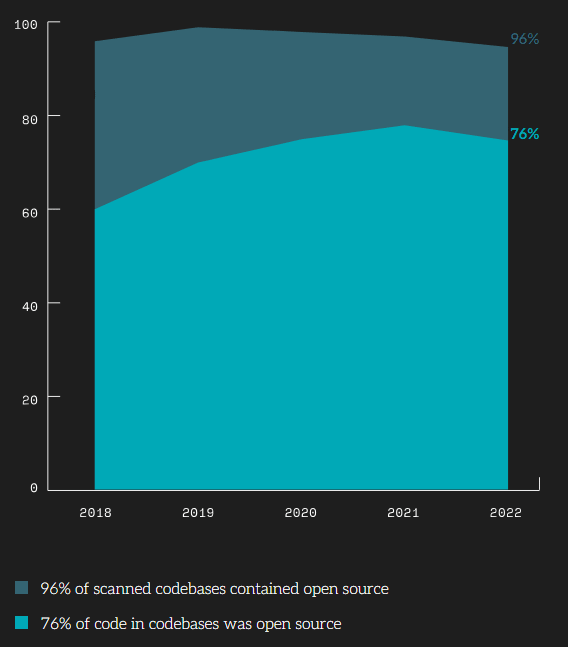
Source: Synopsis 2023 Open Source Security and Risk Analysis Report
This demonstrates our reliance on open-source software ecosystem to produce modern software. While this collaborative approach enhances efficiency, it introduces new risks. Without proper scrutiny, organizations might unknowingly incorporate components with hidden vulnerabilities, leaving their software susceptible to exploitation.
Attack Vectors Multiply
As the software supply chain grows more intricate, so do the attack vectors. Malicious actors can infiltrate the supply chain at any point — inserting malicious code into a seemingly innocent component, compromising a vendor’s infrastructure, or tampering with distribution channels. Each compromised point creates a ripple effect, potentially compromising the security and reliability of the entire software ecosystem.
The Synopsys 2023 Open Source Security and Risk Analysis Report highlighted that the percentage of open-source codebases containing security vulnerabilities remain troublingly high, with 84% codebases containing at least one vulnerability, and 48% of codebases containing high-risk vulnerabilities.
According to the history of attacks recorded by Sonatype since 2017, the attacks show no signs of abating. Sonatype’s 8th Annual State of the Software Supply Chain Report underscores a substantial annual growth rate of 742% in software supply chain attacks.
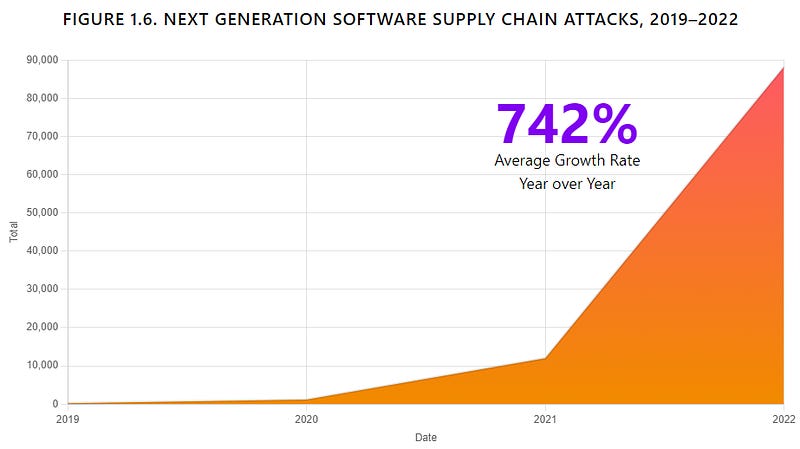
Source: Sonatype 8th Annual State of the Software Supply Chain Report
Potential Consequences of Compromised Supply Chains
The consequences of compromised software supply chains can be far-reaching and severe. Furthermore, compromised software supply chains can lead to cascading security incidents across industries. A single vulnerable component can be leveraged to exploit multiple organizations, making it difficult to contain the scope of an attack.
The interconnectedness of digital systems amplifies the potential for widespread disruption and increases the complexity of incident response efforts. The exploitation of SolarWinds and Log4j vulnerabilities has demonstrated widespread impact across organizations, industry sectors, and nations.
Financial ramifications are immediate for impacted organizations, as breaches can result in loss of revenue, lawsuits, and regulatory fines. The legal liabilities arising from data breaches or system disruptions can lead to costly legal battles that damage a company’s reputation and bottom line.
Reputational damage is another significant concern. The public has grown increasingly aware of the impact of data breaches and security vulnerabilities. Companies with lax supply chain security practices risk losing customer trust, eroding brand loyalty, and driving users to seek more secure alternatives. Reputational damage can have long-lasting effects, with lasting impacts on revenue and business viability.
In response to the growing threat landscape, regulations are evolving to include stricter requirements for software supply chain security, with the US government issuing an Executive Order on Improving the Nation’s Cybersecurity, and the EU proposing an European Cyber Resilience Act (CRA).
Understanding Software Supply Chain Security
Software supply chain security refers to the protection of software applications throughout their entire lifecycle — from conception and development to distribution and maintenance. It encompasses the complex web of processes, resources, and relationships that contribute to the creation, delivery, and management of software. Software supply chain security addresses the vulnerabilities and threats that can exploit weaknesses in any phase of the software’s lifecycle, potentially compromising the security and reliability of the end product.
I have covered more about software supply chain security in my previous articles:
Software Supply Chain Security — An Introduction
*As organizations have matured their capabilities to protect production systems from cyber threats, attackers have…*medium.com
History and Evolution of Software Supply Chain Attacks
*Software supply chain attacks have been increasing rapidly over the last few years, with some high-profile incidents…*medium.com
Addressing the Need for Security
Given the stakes involved, organizations must prioritize software supply chain security as a fundamental element of their overall cybersecurity strategy. This entails a comprehensive approach that considers security at every stage of the software development lifecycle.
One pivotal aspect of this approach is the integration of security practices into the design and development phases. By baking security into the software’s foundation, organizations can identify and mitigate vulnerabilities early, reducing the likelihood of exploitable weaknesses making their way into the final product. This process includes threat modeling, secure coding practices, and regular code reviews to ensure that software is built with security in mind.
Software Bill of Materials (SBOM) has emerged as a key tool in enhancing software supply chain security. An SBOM is akin to a recipe that lists all the ingredients used in a dish. In the context of software, SBOMs provide a detailed inventory of all components, libraries, and dependencies used in an application. This transparency enhances accountability, facilitates risk assessment, and empowers organizations to respond effectively to emerging threats. SBOMs also facilitate collaboration between stakeholders, helping vendors and customers work together to ensure the security of shared software.
Additionally, various initiatives started by organizations such as NIST (SSDF), OpenSSF (SLSA, Sigstore), OWASP (SCVS), among others, focus on bolstering security and integrity of end-to-end software development and delivery processes. A widespread industry adoption of these may take time as new approaches continue to evolve.
A Holistic Approach
The importance of software supply chain security cannot be overstated in our interconnected digital landscape. The increasing complexity and interdependence of software systems demand a holistic approach to security that encompasses the entire software lifecycle. The potential consequences of supply chain vulnerabilities extend beyond financial losses, affecting reputation, customer trust, and even public safety.
As organizations embrace the imperative to secure their software supply chains, collaboration and knowledge sharing become essential. Industry standards, best practices, and innovative solutions must be developed and shared to build a more resilient software ecosystem. By prioritizing software supply chain security, organizations not only protect their interests but also contribute to a safer digital environment for everyone.
Why NOW?
The urgency to address software supply chain security is more critical than ever. As the software ecosystem expands, embracing third-party components and open-source dependencies, the attack surface grows, amplifying risk.
State governments and regulatory bodies are recognizing the urgency of supply chain security, and imposing stricter compliance requirements. Industry groups have responded by coming up with new standards and frameworks.
The interconnectedness of global supply chains and the rapid pace of development demand proactive measures. The time to act is NOW— to fortify software supply chains, mitigate vulnerabilities, and establish robust security practices. It’s a collective responsibility that encompasses developers, vendors, security experts, and management.
Organizations must prioritize supply chain security to safeguard their assets, maintain consumer trust, and adapt to the evolving threat landscape. As software continues to shape our world, securing its supply chain becomes an imperative to ensure a safer and more reliable digital future.